
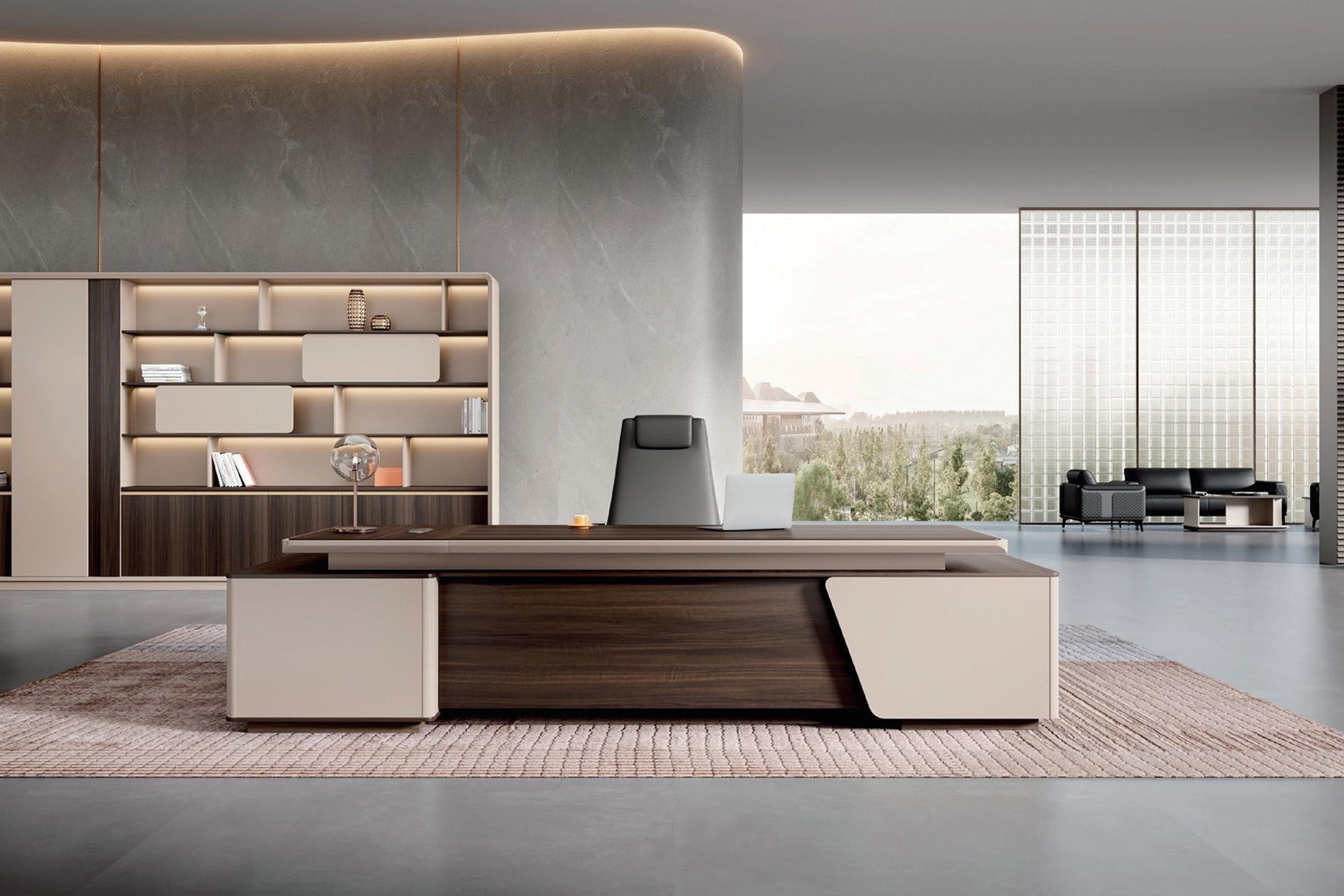


The contractor says the office will be ready on Friday and your first clients arrive Monday. Then the carrier calls: the reception desk can be delivered next week, the conference table needs an appointment, and nobody has checked whether the executive desk fits in the elevator.
The problem is not the chair or finish. It is using opening day as the delivery deadline. Set a furniture-ready date 7 to 10 days earlier; for made-to-order, customized or multi-room purchases, begin 10 to 16 weeks before opening.
Opening Day Is the Wrong Delivery Target
A delivery estimate does not include room placement, assembly, leveling, powered-feature testing, packaging removal or correction of a damaged or incomplete shipment.
That is why the real target is not opening day. It is the furniture-ready date, normally 7 to 14 days earlier.
Zimasya currently labels eligible products in its Ships Today collection for delivery in approximately 7 to 14 days. Its current shipping policy explains that most made-to-order furniture involves processing, international transit, customs, warehouse transfer and local delivery. Product availability and delivery conditions can change, so the exact item page and written order confirmation should control the final schedule.
Use a Safer Planning Window
The windows below are planning buffers, not delivery guarantees. For every item, record its stock status, the date the quote was issued, the event that starts the lead time and the promised ship or delivery window. If the exact configuration is not confirmed in writing, do not treat it as ready stock.
|
Order type |
Safer time to order |
Why the buffer matters |
|
Confirmed in-stock essentials |
3 to 4 weeks before opening |
Allows time beyond the displayed delivery estimate for scheduling, inspection and assembly |
|
Standard made-to-order furniture |
10 to 12 weeks before opening |
Covers production, freight, customs, local delivery and a 7-to-14-day setup buffer |
|
Highly custom or multi-room order |
12 to 16+ weeks before opening |
Adds time for drawings, finish approvals, branding, coordinated delivery and installation |

If the opening date cannot move, divide the purchase into "Day 1" and "Phase 2." Ask whether the seller holds an order until every item is ready. If so, place opening-critical in-stock pieces separately so a custom conference table cannot delay the reception desk.
Build the Schedule Backward From Five Milestones
Instead of asking, "How long will shipping take?" build the plan backward from the date the office must function.
- Opening day:Employees are working and the public can enter the space.
- Furniture-ready date:One named owner signs off on the completed punch list.
- Delivery and installation date:The dock, elevator, installer and cleared rooms are all confirmed.
- Confirmed ship date:Production is complete and a tracking record or logistics booking exists.
- Order approval date:An approved quote or drawing locks the sizes, colors, orientation, quantity, address and service level.
Put an owner, due date and proof beside each milestone: an approved drawing, booking confirmation, tracking record or signed punch list. If one milestone slips, reduce the scope instead of removing the installation buffer.
12 to 16 Weeks Before Opening: Lock the Room, Not Just the Style
At this stage, freeze one dated furniture plan against the latest construction and electrical drawings. If the room changes later, the furniture decision must be reviewed again.
Create a delivery-route sheet, not just a room measurement. Record the narrowest clear door width after hinges and closers, elevator door width and cab depth, corridor width, tightest turn, lowest obstruction and final doorway. Add photos with the tape measure visible. Compare those numbers with the largest carton or unassembled component, not only the finished desk footprint.
Match the first purchase to the work that must happen on opening day: a reception desk for check-in and privacy, an executive desk for a working management office, or a conference table when group meetings are operationally essential.
Do not approve a furniture package until these questions have answers:
- Is each item labeled Day 1, revenue-critical or Phase 2?
- What is the largest packaged component, and where is the tightest point on its route?
- Is an L-shaped desk handed correctly when viewed from the seated position?
- Does the equipment plan show every outlet, data point, monitor arm, POS device and printer?
- Where will cartons be staged, and what clear floor area will installers use?
- Who is the single approver, and how quickly must that person answer a drawing request?
10 to 12 Weeks Before Opening: Place Made-to-Order Purchases
Once the layout is stable, convert preferences into a signed order sheet. For each product, record the SKU, overall dimensions, finish code, quantity and configuration. Include left-or-right orientation as viewed from the seated side, lock and key requirements, logo file and position, cable module, chair count and every requested change.
Ask which event starts the quoted lead time: payment, drawing approval or another release step. Also ask whether the order ships in parts or only when every item is complete. Put the delivery service on its own quote line: curbside, threshold, room-of-choice, assembly and debris removal are different scopes. List stairs, elevator access, dock limits and after-hours rules, then write down any exclusions.
Use the Zimasya FAQs as a starting point, but get order-specific answers in writing. Save one dated PDF containing the approved configuration, delivery address, contact information, service level and quote. If the buyer is unavailable, another person should be able to verify the order without searching through an email thread.
After approval, do not accept verbal changes. Any change request should show the old specification, new specification, added cost and revised ship window, then return to the same named approver.
4 to 6 Weeks Before Opening: Make the Site Deliverable
Use a short site-release checklist signed by the project lead or contractor. Flooring, paint and overhead work should be complete; power and data should be live at the planned positions; protective covering should be installed where required; and the destination rooms and staging area should be empty. If a desk includes lighting or a cable box, test the intended outlet before delivery.
Walk the full delivery path with the route sheet. Ask property management for the exact certificate-of-insurance wording, freight-elevator reservation process, service hours, dock height or truck-size limits, floor-protection rules and after-hours fees. Mark the smallest clearance and the tightest turn on the floor plan, then send the marked route to the installer before the truck is scheduled.
Label a staging area by room or item number. Cartons should not block the entrance, fire route or installer work zone, and construction materials should be removed before the crew arrives.

2 to 3 Weeks Before Opening: Confirm the Final Mile
Confirm the delivery address, ZIP code, suite number, on-site contact and backup phone number. Reconfirm the service level, unloading responsibility and whether assembly occurs on delivery day or during a separate appointment. Ask the recipient to reply with an explicit confirmation instead of assuming that a sent email was read.
Create a one-page delivery note that includes:
- Building and suite access instructions
- Loading dock or parking location
- Elevator reservation time
- On-site contact and backup contact
- Final room for each item
- Approved floor plan
- Assembly and packaging-removal responsibilities
Attach the approved floor plan and route photos, export the packet as one PDF and require acknowledgement from the carrier or installer, building manager and project lead. Keep the confirmed packet in the shared project folder.
7 to 10 Days Before Opening: Deliver, Inspect and Test
Assign one receiver who has the order sheet, carton count, delivery packet and a charged phone for photos. That person should be free to inspect the shipment rather than simultaneously covering reception or supervising another trade.
Before cartons are moved or opened, photograph all visible damage, model labels and shipping labels. Count cartons against the delivery record and note exceptions on the receipt. During unpacking, keep hardware grouped by item and compare the delivered color, size and orientation with the approved order sheet. Do not discard packaging until the functional check is complete and the applicable policy has been reviewed.
After setup, test every moving or powered feature:
- Open and close drawers, doors and locks; confirm that the desk is level.
- Test lighting, outlets, USB ports and cable boxes under normal use.
- Place monitors, phones, POS equipment and printers in their final positions.
- Pull chairs out fully and verify visitor access, circulation and exit paths.
Review the return and refund policy before opening or assembling a package, especially for customized products. If something is damaged or missing, preserve the evidence and contact support promptly rather than waiting until after opening day.
What If Opening Day Is Less Than 30 Days Away?
Do not try to compress a custom furniture project into an in-stock schedule. Reduce the day-one scope.
Mark every item as an opening blocker, revenue or privacy blocker, or noncritical. Day 1 contains only the first two groups. A reception counter needed for POS or privacy belongs in the first phase; lounge seating and a custom boardroom table usually do not.
Confirm the exact SKU, destination and service level. Even for an eligible item labeled for delivery in 7 to 14 days, retain time for scheduling, assembly and issue resolution.
For a temporary layout, specify one working reception position, essential workstations, lockable storage and safely managed cables. Give every temporary item a removal date.
Six Schedule Killers to Catch Early
1. Finalizing the Furniture Before the Floor Plan
Do not release the order until the furniture plan and electrical plan carry compatible revision dates. Mark outlets, floor boxes, doors and fixed millwork on the approved furniture plan.
2. Changing Specifications After Production Starts
Use a change log with the original specification, revised specification, cost impact, schedule impact, approver and approval time. No entry means no change.
3. Ignoring the Delivery Route
Compare the largest carton or component with the smallest measured opening and every turn. If the fit is close, send measurements and route photos to the seller or installer for written review before ordering.
4. Assuming Curbside Delivery Includes Assembly
Create a service matrix that states who unloads, moves items to the room, assembles, levels, connects powered features and removes packaging. Price each missing responsibility before delivery day.
5. Scheduling Delivery Into an Active Construction Site
Require a site-release signoff before confirming the truck. If the contractor cannot release the route and destination rooms, use approved protected storage or move the delivery date.
6. Leaving No Time for a Punch List
Create the punch list while the installers are still on site. Give every issue a photo, item number, owner, promised response and due date; close the list only after the correction is verified.
Frequently Asked Questions
How far in advance should I order office furniture?
Begin 10 to 12 weeks ahead for standard made-to-order furniture and 12 to 16 weeks ahead for customized or multi-room projects. Confirmed in-stock essentials may fit 3 to 4 weeks if installation time is protected.
Can in-stock office furniture arrive in 7 to 14 days?
Some eligible Zimasya products are labeled for delivery in 7 to 14 days. Confirm the exact SKU, address and service level before relying on that window.
Should furniture arrive before construction is finished?
Usually no. Release the destination rooms and route only after floors, paint, power and overhead work are complete. Otherwise, arrange approved protected storage.
What should I send the furniture seller before ordering?
Send the opening date, approved floor plan, configuration sheet, route measurements and photos, building restrictions, delivery address and required service level.
Give the Office a Finish Line Before Opening Day
Set the furniture-ready milestone 7 to 14 days before opening. Match the product scope to the available window and keep specifications, site access and delivery responsibility in one approved packet.
If your schedule includes custom dimensions, several rooms or a hard opening date, contact Zimasya before placing the order. A clear deadline, floor plan and delivery description give the team a better chance to recommend an option that fits both the space and the calendar.


