
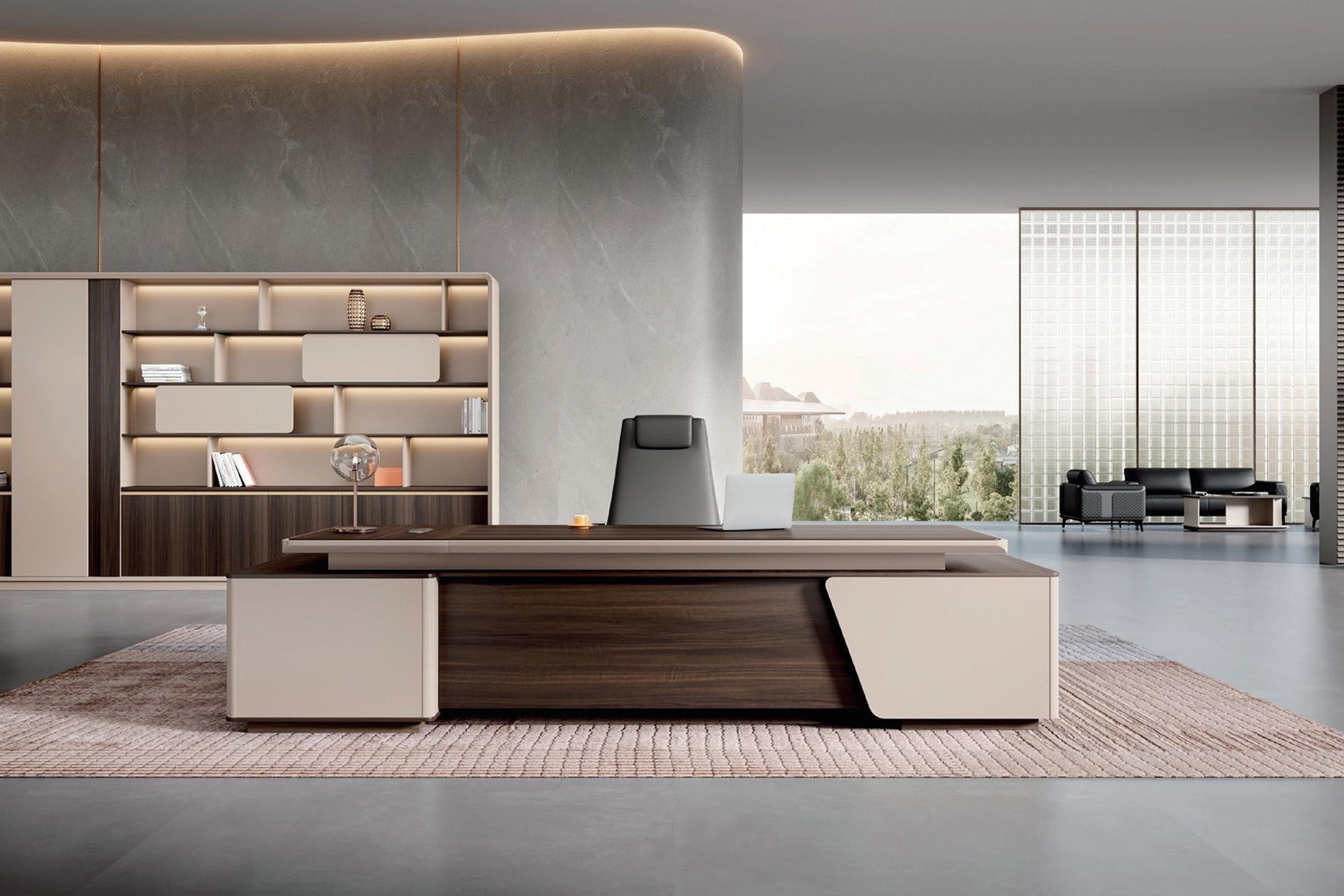

An L-shaped executive desk can create separate zones for computer work, meetings, files, and equipment while maintaining a professional front-facing surface. The right configuration organizes the office; the wrong one can block doors or place storage on an inconvenient side.
If you are comparing an l shaped executive desk online, begin with the room rather than the finish. Measure both walls, choose the return side, and account for drawers, cables, visitors, and delivery.
This guide explains common sizes, left- and right-hand layouts, room clearances, storage choices, and technology planning. It also shows when an L-shaped layout offers more value than a straight executive desk.
Planning note: Dimensions, orientation labels, availability, customization, and delivery times vary by product. Always check the drawing and selected variant before ordering.
L-Shaped Executive Desk: Quick Buying Comparison
|
Priority |
Recommended direction |
Why it matters |
|
Compact manager’s office |
63–71 in. main desk |
Provides an executive layout without dominating a smaller room |
|
Standard private office |
79–94 in. main desk |
Balances desktop space, storage, and visitor seating |
|
Large executive suite |
102–118 in. main desk |
Supports multiple monitors, documents, meetings, and substantial storage |
|
Statement office or boardroom setting |
126 in. or more |
Creates visual presence but requires careful circulation and delivery planning |
|
Frequent computer and equipment use |
Return with cable access and ventilated storage |
Keeps devices organized and separates technology from the main work surface |
|
Confidential files |
Lockable drawers or side cabinet |
Keeps important documents close to the user |
These are planning categories, not universal standards. Zimasya’s L-shaped executive desk collection includes multiple lengths and return depths, so compare the complete footprint.
What Makes an Executive Desk Different?
An executive office desk is generally larger than a basic workstation and may include a privacy panel, thicker desktop, side cabinet, drawers, and cable access.
The return can support a printer, secondary monitor, paperwork, or brief discussions without filling the main desktop. It also defines the user’s work zone.
Well-positioned storage matters more than size alone. A large desk creates little value when the user must reach or walk around an inconvenient cabinet.
Common L-Shaped Desk Dimensions
Current Zimasya products show how widely L-shaped desk dimensions vary. Configurations may range from about 63 inches to 118 or 126 inches long, while return and cabinet dimensions differ by model.
|
Main desk length |
Typical application |
Planning considerations |
|
63–71 in. |
Home office, team leader, or compact manager’s room |
Confirm monitor space and whether the return contains storage or only a worktop |
|
79–94 in. |
Standard manager, director, or professional office |
Usually provides room for equipment, documents, and one or two visitor chairs |
|
102–118 in. |
Senior executive office or equipment-heavy work |
Requires a wider delivery route and more space behind and around the desk |
|
126+ in. |
Large suite, luxury office, or statement setting |
Plan the room, storage wall, meeting area, and installation as one layout |
One configurable manager’s executive desk offers 71-, 79-, 87-, and 94-inch lengths, with changing return dimensions. Product drawings should take priority over category labels.
Desk height
Many executive desks use a surface close to 30 inches high. Check underside clearance because desktops, drawers, panels, and cable trays affect legroom.
Return depth
The second listed dimension may describe the return, side cabinet, or overall footprint—not usable desktop depth. Check the drawing for cabinets, shelves, and knee space.
How Much Room Does an L-Shaped Desk Need?
Start with the complete footprint, then add room for the user’s chair, drawers, cabinet doors, entry, and visitor seating.
As a starting point, allow approximately 36 inches behind the user’s chair for basic movement and more when it is also a walkway. Include visitor-chair pullout space.
Also confirm:
- Door swing and the route from the entrance to the visitor chairs
- Window, outlet, floor-box, thermostat, and air-vent locations
- Access to drawers, shelves, and lockable cabinets
- Clearance between the return and nearby walls or furniture
- Camera background and sightlines for video meetings
- Delivery access through doors, elevators, corridors, and turns
An oversized modern executive desk should not reduce circulation to a narrow path.
Left-Hand vs. Right-Hand Return
Return direction is easy to order incorrectly. A left-hand L-shaped desk places the return on the left and a right-hand L-shaped desk on the right, but manufacturers may use the seated or visitor-facing view.
Check the product image, drawing, and written orientation. A cabinet may be left, right, or interchangeable depending on the model.
Choose the return side according to:
- The user’s dominant workflow and preferred equipment position
- The nearest power and data connections
- Door and visitor approach
- Access to storage without blocking the chair
- Windows, views, and screen glare
- The path to a printer, file cabinet, or meeting area
Mark a fixed return on the floor plan. For an interchangeable return, confirm any effect on assembly, cables, or drawers.
Straight Desk vs. L-Shaped Executive Desk
A straight desk suits a narrow room or an office with separate storage. It is easier to position and may preserve more open floor area.
An L-shaped desk suits multiple work zones, integrated storage, or a larger computer setup. The return keeps equipment nearby while preserving the main surface.
Choose a straight design when:
- The office is narrow or frequently rearranged
- Most documents and equipment are stored elsewhere
- The user prefers a simple, symmetrical layout
- Visitor seating and circulation need priority
Choose an L-shaped design when:
- The user works with several screens or devices
- Files and supplies must remain within reach
- The desk needs separate computer and meeting surfaces
- A corner or side wall can support the return efficiently
Browse the complete executive desk collection to compare straight, L-shaped, modern, and luxury configurations.
Choosing an Executive Desk With Storage
An executive desk with storage should reduce movement and clutter without taking away legroom. Decide what each compartment will hold.
Side cabinet
A side cabinet can hold a printer, computer, files, or personal items. Check ventilation, orientation, and whether the cabinet is structural or movable.
Lockable drawers
Confirm which drawers lock and whether one lock controls several compartments.
Open shelves
Open shelves keep daily files accessible but are unsuitable for private items.
Separate file cabinet
A matching file cabinet adds capacity and can make future layout changes easier.
The best storage plan places daily items within reach, occasional files nearby, and archives in a separate cabinet or storage room.
Cable Management and Technology
Before choosing a desk, list every monitor, computer, phone, charger, lamp, docking station, and conference device.
Look for:
- Cable grommets or desktop cable boxes in useful positions
- A concealed path from the desktop to the outlet or floor box
- Ventilation around computers and power equipment
- Access for maintenance without emptying the cabinet
- Enough outlets for current equipment and reasonable expansion
- Separation between power cables and visitor leg space
Some Zimasya executive desk designs include cable-management boxes and multiple size options. Confirm the box location against the intended monitor position before selecting a variant.
Matching the Desk to the Office Style
A modern executive desk often uses clean lines, mixed wood tones, neutral panels, metal details, and concealed storage. Luxury designs may add thicker tops, curves, gloss, or lighting.
Coordinate the finish with flooring, walls, storage, guest chairs, and conference furniture. A consistent palette is usually more professional than unrelated statement finishes.
Dark walnut and black feel formal but can appear heavy in a small room. Light wood, gray, white, and khaki may feel more open. Verify finishes when color matching matters.
In-Stock vs. Made-to-Order Executive Desks
Selected Zimasya in-stock executive desks currently list expected U.S. delivery around 7–14 days, while many made-to-order models list approximately 6–8 weeks. Confirm the selected variant and destination.
In-stock furniture supports fixed dates and quick replacements. Made-to-order products offer more configuration choices but need longer planning. Zimasya’s FAQ page states that many products support size, color, or configuration changes, subject to confirmation.
Do not schedule delivery for the final day before an office opens. Leave time for receiving, inspection, assembly, cable setup, and correction of any shipping or specification issue.
How to Measure Before Ordering
Use one drawing that shows the room, desk, storage, chairs, and circulation:
- Measure every wall and mark doors, windows, columns, and built-in elements.
- Add outlets, floor boxes, data connections, vents, and thermostats.
- Draw the full main desk and return dimensions at the same scale.
- Mark whether the return is left, right, fixed, or interchangeable.
- Add the user’s chair, visitor chairs, open drawers, and cabinet doors.
- Check the walking route from the door to every seat and storage area.
- Measure the delivery route, including elevators, corridors, and turns.
- Compare the drawing with the exact product variant before payment.
Photographs can help explain the room, but they do not replace measurements.
Common Buying Mistakes
- Comparing only the front length and ignoring the return depth
- Ordering the return on the wrong side
- Forgetting chair movement and visitor seating
- Blocking doors, outlets, windows, or air vents
- Assuming every cabinet is movable or reversible
- Choosing storage before listing what it must hold
- Failing to plan monitor, power, and cable locations
- Measuring the office but not the delivery path
- Treating a made-to-order lead time as an exact arrival guarantee
Frequently Asked Questions
What is a good size for an L-shaped executive desk?
Start around 63 to 71 inches for a compact office, 79 to 94 inches for many private offices, and 102 inches or more for large suites. Return depth and clearance also matter.
Is a left- or right-hand L-shaped desk better?
Choose the side that supports workflow, entrance, outlets, storage, windows, and visitors. Confirm how the manufacturer defines orientation.
How much clearance is needed behind an executive desk?
Approximately 36 inches is a practical starting allowance. Add space when people walk behind the user or cabinets open there.
Should the return hold the computer or storage?
It can hold either. A technology return works well when cable access and ventilation are correctly positioned. A storage return is useful when documents and supplies need to remain close without filling the main desktop.
Can an executive desk be customized?
Many Zimasya products offer customization in size, color, or configuration. Options vary, so confirm the drawing, return direction, finish, price, and lead time before ordering.
Are large executive desks difficult to deliver?
They can be. Large desks often arrive in sections, but individual panels, tops, and cabinets may still be heavy or oversized. Measure loading access, doors, elevators, corridors, turns, and assembly space.
Choose the Layout Before the Finish
The right L-shaped executive desk should support the user’s work, fit the room comfortably, place storage on the correct side, and keep technology organized. Size and orientation affect daily function far more than a finish viewed in isolation.
Begin with a scaled floor plan and a list of equipment, storage, and visitor needs. Confirm the complete footprint, return direction, delivery path, and product lead time. Once those requirements are correct, choose the materials and style that complete the office.
Explore Zimasya’s L-shaped executive desks, or review the full office furniture collection to coordinate desks, chairs, cabinets, and meeting furniture.


