
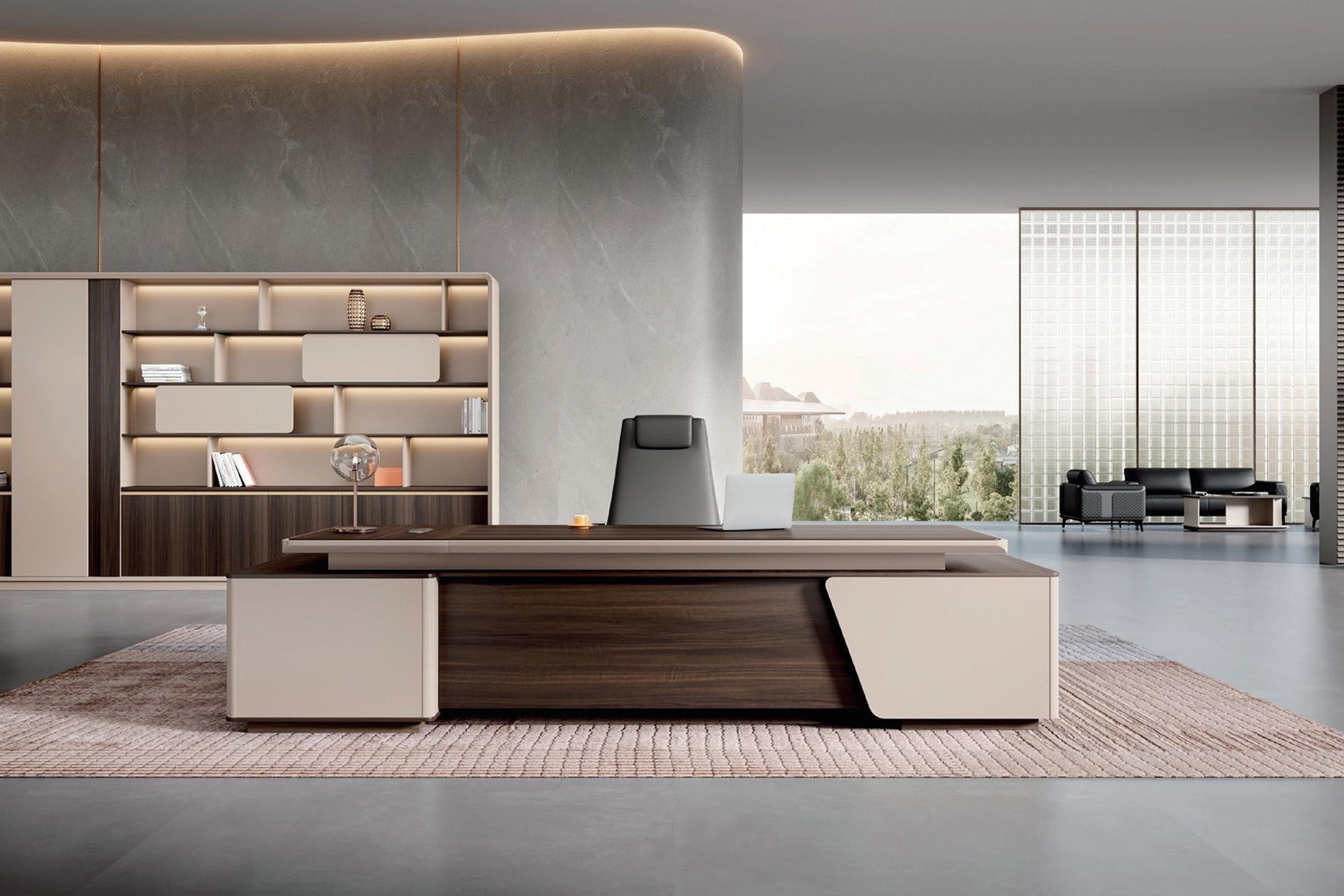


One product page says MDF. Another says particleboard. A third says melamine board, engineered wood, or simply panel. It is tempting to turn those labels into a ranking and choose whichever material sounds more substantial.
That shortcut often leads to the wrong decision.
The board name tells you what is inside one part of the furniture. It does not tell you how thick the desktop is, how far it spans without support, whether the edges and cable openings are sealed, or whether the joints will handle a future move.
If you need a quick starting point, consider MDF when a smooth painted or curved face is important, and surfaced particleboard for flat panels and cabinet parts. For a long desktop, a wet-prone edge, or furniture that may be moved, judge the support, sealing, and connectors before choosing either one.
Four Product-Page Terms That Are Easy to Confuse
Furniture listings often place several kinds of material language in the same field. Before comparing products in Zimasya's office furniture collection, sort each term into one of four layers.
- Core material:MDF and particleboard describe the wood-based panel beneath the visible surface. Plywood and solid wood are different core or structural materials.
- Surface material:Melamine, laminate, wood veneer, and decorative film describe what may be applied over a core. A surface name alone may not identify the board underneath.
- Finish:Lacquer, paint, and clear coating describe how a visible surface is finished. They can change appearance and cleanability without changing the core.
- Emission class or compliance statement:E1 and TSCA Title VI relate to formaldehyde emissions. They do not describe load capacity, scratch resistance, or waterproofing.
Color names sit outside all four layers. "Walnut," "oak," or "marble pattern" may describe appearance rather than solid walnut, solid oak, or stone. If a listing uses a wood species as a color, check the specification instead of assuming that is the structural material.

A "melamine board desk" may have a melamine-faced particleboard or MDF core. A lacquered desk can also be made from MDF. When a listing uses only a surface term, ask one direct question: What is the substrate under this finish?
Where MDF and Particleboard Each Make Sense
Both MDF and particleboard are composite wood panels made by combining wood material with a binder under heat and pressure. The difference is the form of that wood material.
Medium-density fiberboard (MDF) is made from fine wood fibers. Its uniform interior creates a smooth surface and allows consistent machining, which is why it is common behind painted panels, rounded profiles, and detailed reception fronts. It is often relatively dense and heavy. At exposed edges, cable cutouts, and screw locations, sealing and suitable fasteners still matter.
Particleboard is made from wood particles rather than fine fibers. It is widely used in flat furniture panels, cabinets, shelves, and work surfaces with a decorative face applied over it. It can be a sensible choice when the panel is well supported and the edges are finished. Long unsupported surfaces and fasteners driven repeatedly into an edge deserve closer inspection.
A well-supported particleboard desktop with sound edge banding can be a better purchase than a long MDF top with too little support. Conversely, MDF may be the more practical choice for a seamless painted curve that would be difficult to produce cleanly from a coarse core. The intended part and construction decide the answer.
The Desktop Span May Matter More Than the Core
Picture two desktops made from the same board. One is supported by cabinets near both ends and a frame underneath. The other stretches across a long opening with minimal support. They should not be expected to perform the same way.
For a long executive desk, conference table, or reception counter, check:
- the finished desktop thickness;
- the distance between structural supports;
- whether there is a steel frame, modesty panel, cabinet, or stretcher below;
- where monitors, equipment, or stone-look decorative panels add concentrated weight;
- whether the longest size option uses additional support compared with the shortest one.
Do not assume that a 2-inch-looking edge means a 2-inch solid panel. Some designs wrap a thinner work surface with a built-up edge or apron. Ask for the actual panel thickness and an underside photo. In the photo, look for a steel rail, full-height modesty panel, center leg, or cabinet directly below the open span.
The Minimalist Executive Office Desk with Storage Side Cabinet, for example, lists particleboard and offers several desk lengths and configurations. Before choosing a longer version, confirm where the side cabinet sits, whether the open work span changes, and whether the longest option adds another support. Do not infer the construction of the longest option from a photo of the shortest one.
Edges, Corners, and Cutouts Reveal the Weak Spots
The center of a coated desktop rarely sees the same exposure as its perimeter. Cleaning moisture collects along edges. A chair or vacuum hits lower corners. Plug heads scrape cable openings. Fasteners enter panel edges during assembly.
Inspect the locations where the core is easiest to expose:
- the front edge where forearms and chair arms make repeated contact;
- cable holes and removable cable-box openings;
- the lower edges of reception desks near mopping;
- sink, coffee station, or planter-adjacent panels;
- cabinet doors around handles and hinges;
- corners likely to be struck during delivery or relocation.
In close-up photos, reject or question visible gaps, lifting bands, crushed corners, rough fibers inside a cable hole, or a lower panel that appears to end in an unprotected raw edge. A small seam where edge banding meets is normal; a gap that exposes the core is not the same thing. Painted or lacquered edges should look even at the corners, where a thin finish is easiest to notice.
"Water-resistant surface" does not make the entire desk waterproof. A decorative face may tolerate a damp cloth while an unsealed cutout or damaged edge remains vulnerable. Clean spills promptly and follow the care instructions for the actual finish.

Hardware Determines Whether the Desk Survives a Move
Many offices do not keep furniture in one layout forever. A desk may be disassembled for relocation, mirrored into a new room, or opened later to add power and data cables. At that point, connector design becomes more important than a broad material label.
Look for metal threaded inserts, cam connectors, dowels, brackets, or bolts designed for the panel. In an assembly diagram, repeated-move-friendly joints usually show a removable metal connector rather than a wood screw cutting directly into the panel. If the diagram is unavailable, ask whether the main desk-to-cabinet connection can be released without removing screws from a board edge.
For furniture likely to move:
- Keep the original hardware labeled by component.
- Photograph the underside and cable route before disassembly.
- Lift panels instead of dragging the assembled desk across the floor.
- Do not overtighten fasteners in an attempt to remove a small gap.
- Ask for replacement hardware rather than substituting a longer screw that may damage the panel.
If the desk will probably stay in one room, this may be a secondary concern. If you lease the office, reconfigure teams, or expect a move within a few years, connector type and replacement-hardware availability belong near the top of the buying checklist.
Choose the Finish for the Workday
The finish is the part employees actually touch, clean, and look at every day. Compare it according to the work that happens on it.
Melamine-faced panels are practical for flat office surfaces where a consistent color and straightforward cleaning matter. Check the substrate, edge banding, and care guidance; "melamine board" by itself does not identify all three.
Laminate surfaces can suit busy shared desks and meeting tables, but products sold as laminate do not all use the same construction or performance level. Ask whether the listing refers to a laminate face or uses "laminate" as a broad category label, and request the care instructions before placing hot equipment or using strong cleaners.
Wood veneer is useful when natural grain variation matters more than a perfectly uniform pattern. Because it is a thin layer of real wood, expect some variation and use care instructions written for veneer rather than plastic laminate.
Lacquered or painted surfaces work well for seamless curves and polished reception fronts. Glossy dark colors usually make fingerprints and fine surface marks easier to see; textured wood-grain finishes are often more forgiving in daily use. Inspect corners and high-touch edges first, not just the broad front panel.
The Minimalist Office Executive Desk with Drawers and Cable Management lists melamine board. If you are comparing it with an MDF desk, ask Zimasya to confirm the substrate and finished desktop thickness, then compare the two products at the front edge, cable box, open span, and cabinet connection—not just in the material row.
What E1 Does—and Does Not—Tell You
E1 is a formaldehyde-emission classification used for wood-based panels under European standards. It is not shorthand for "solid wood," "chemical-free," or "premium quality." It also does not rate structural strength, screw holding, surface durability, or moisture resistance.
For furniture being sold in the United States, a separate and more directly relevant question is whether regulated composite wood components and finished goods comply with TSCA Title VI requirements. Do not assume that an E1 statement and a U.S. compliance statement are interchangeable; they come from different regulatory frameworks and documentation requirements.
The Modern Office Reception Desk with Storage Cabinet and LED Lighting lists E1-grade MDF. Read that as two separate statements: the core is MDF, and the product makes an E1-related emissions claim. It is not a statement about the desk's load capacity or its resistance to wet mopping.
Avoid using odor as a home compliance test. Packaging, coatings, adhesives, and other materials can contribute to a new-furniture smell, while the absence of a strong smell proves nothing about a particular emissions result. For a U.S. order, ask for the TSCA Title VI compliance statement or a photo/copy of the relevant finished-good or package label before the furniture is shipped. The label should identify the fabricator, production date, and TSCA Title VI compliance statement.
Ask Better Questions Before You Buy
"Is this desk high quality?" invites a broad marketing answer. A short request tied to the exact configuration is easier for both sides to verify.
You can send this:
I am considering [product name], [size], [color], [left/right configuration]. Before ordering, please confirm the desktop core and finished thickness, the surface finish, the support under the longest open span, the treatment around cable openings and lower edges, the connector type between the desk and cabinet, and the TSCA Title VI compliance information for the finished product. Please also send close-up photos of one finished edge, one cable opening, and the underside support for this size.
If you need to compare several products, use the answers to check:
- whether the seller named the core and surface separately;
- whether the stated thickness is the actual panel or only a built-up edge;
- whether the underside photo matches the size you selected;
- whether cable holes and lower edges show exposed board;
- whether the main connectors are removable and replacement hardware is available;
- whether emissions documentation applies to the finished U.S. product rather than only describing a board grade;
- whether care instructions name the actual surface.
If the reply repeats "premium eco-friendly board" without answering the substrate, thickness, support, or label question, the material description is still incomplete. That does not prove the furniture is poor, but it means you cannot make a technical comparison from the information supplied.
Zimasya's office desk guide provides a broader overview of desk types and materials. Use that overview to narrow the category, then use the questions above to evaluate the exact configuration.
Spend Your Attention Where the Risk Is
Different workplaces should prioritize different details.
- Reception and checkout counters:Inspect front corners, lower edges exposed to mopping, cable cutouts, and panels carrying POS equipment.
- Long executive desks:Ask for the underside structure of the exact length and check whether the side cabinet shortens the unsupported span.
- Employee workstations:Prioritize edge durability, cable-access points, replaceable hardware, and joints that may be released during reconfiguration.
- Storage cabinets:Check loaded shelf span, hinge mounting, drawer movement, anchoring instructions, and protection from wet floors.
- Meeting tables:Check frame support, base placement, cable-box cutouts, and care instructions for frequent cleaning.
The result may be different within one order: MDF may make sense for a curved, lacquered reception front, while surfaced particleboard works well for the supported storage cabinet behind it. There is no benefit in forcing every component into a single material ranking.
Frequently Asked Questions
Is MDF better than particleboard for an office desk?
Choose MDF first for a smooth painted or shaped face. Consider surfaced particleboard for flat, supported panels and cabinet parts. For a long desktop, compare the actual thickness, underside support, edge sealing, and connectors before using the core name as the deciding factor.
Does E1 MDF mean the desk is formaldehyde-free?
No. E1 is an emissions classification, not a claim that the board contains or emits absolutely no formaldehyde. It says nothing about strength or water resistance. For a U.S. project, ask what TSCA Title VI compliance information applies to the finished product.
Is melamine board the same as particleboard?
Not necessarily. Melamine usually describes the decorative surface; the substrate beneath it may be particleboard or MDF. Ask the seller to name both the surface and the core.
Can MDF or particleboard furniture get wet?
A finished surface may tolerate normal wiping, but standing water can reach seams, damaged edges, fastener holes, or cable cutouts. Wipe spills promptly and inspect lower edges and cutouts instead of treating a water-resistant face as proof that the assembled desk is waterproof.
Which material is better if the office may relocate?
Judge the connection system first. Metal inserts, bolts, cams, brackets, replacement hardware, and clear assembly instructions matter more during relocation than the broad board category. Avoid designs that require screws to be driven repeatedly into the same panel edge.
How can I judge an office desk material when buying online?
Ask for the core, surface, finished desktop thickness, underside support, edge treatment, connector type, and applicable emissions documentation for the exact size. Request three close-ups: one edge, one cable opening, and the underside of the longest span.
Read the Construction, Not Just the Material Line
If a product page gives only one vague material word, you do not yet have enough information to compare it with another desk. Get the core, face, thickness, support, edge treatment, connectors, and U.S. compliance information for the exact size.
A practical purchase can use either MDF or particleboard. The better choice is the one whose construction matches the part: a shaped painted face, a supported flat panel, a long work surface, or a desk that must come apart again.


