

How to Furnish an Office for 10, 20, or 50 Employees
Scaling a business is an exhilarating journey, but it brings unique architectural and operational challenges. As your headcount grows from a tight-knit team of 10 to a structured organization of 50, your office furniture requirements shift from simple utility to complex spatial ecosystems. A well-planned office is not just a place to sit; it is a retention tool, a productivity engine, and a physical manifestation of your brand’s maturity.
Whether you are designing a boutique studio or a sprawling corporate floor, this guide breaks down the essential furniture strategies for every stage of growth.
The Core Philosophy: Scalability and Ergonomics
Regardless of your size, two non-negotiables should drive every purchase: Ergonomics and Modularity.
In the modern professional landscape, the "Standard Desk" is being replaced by the height-adjustable (sit-stand) desk. Providing employees with the ability to transition from sitting to standing—ideally with a smooth dual-motor system—is the single best investment in long-term health and focus. Pair these with BIFMA-certified ergonomic task chairs featuring 4D armrests and synchronized tilt mechanisms to ensure your team remains injury-free as they drive your business forward.
Phase 1: Furnishing for 10 Employees (The Boutique Startup)
At this stage, the atmosphere is usually collaborative, fast-paced, and fluid. Your furniture should reflect this "all-hands-on-deck" culture.
Spatial Strategy: The Open Hub
For 10 people, a "Cellular" office (individual rooms) often kills the creative spark. Instead, opt for an Open Benching System. This allows for immediate communication and a sense of shared mission.
- The Primary Workstations: Five sets of dual-user face-to-face benches. This saves space and centralizes cable management.
- The "Japandi" Influence: For small teams, a Japandi aesthetic (Japanese minimalism meets Scandinavian functionality) works beautifully. Use light oak textures and slim white metal frames to make a small footprint feel airy and expansive.
- The Multitasking Conference Room: You likely only have one meeting room. Equip it with a premium 94.5" boat-shaped conference table with integrated flip-top power hubs. This room will serve as a boardroom, a lunchroom, and a client pitch zone.
Phase 2: Furnishing for 20 Employees (The Emerging Growth Stage)
Moving to 20 employees is a tipping point. The "one big room" starts to get noisy, and different departments (e.g., Sales vs. Engineering) begin to have conflicting environmental needs.
Spatial Strategy: Defined Zones
At 20 people, you need to introduce "Zonal Planning" to manage acoustics and focus.
- Workstations: Move toward 120-degree triple workstations. These "clover" shapes offer more privacy than straight benches and provide each employee with a larger primary work surface, which is essential for developers or designers using dual monitors.
- Acoustic Privacy: Introduce PET-felt desk dividers. At 20 people, the "chatter" becomes a distraction. High-performance acoustic panels help dampen mid-range frequencies without closing people off visually.
- The Phone Booth Addition: Install 1–2 acoustic privacy pods. These allow employees to take private calls or Zoom meetings without occupying the main conference room, which is now likely in constant demand.
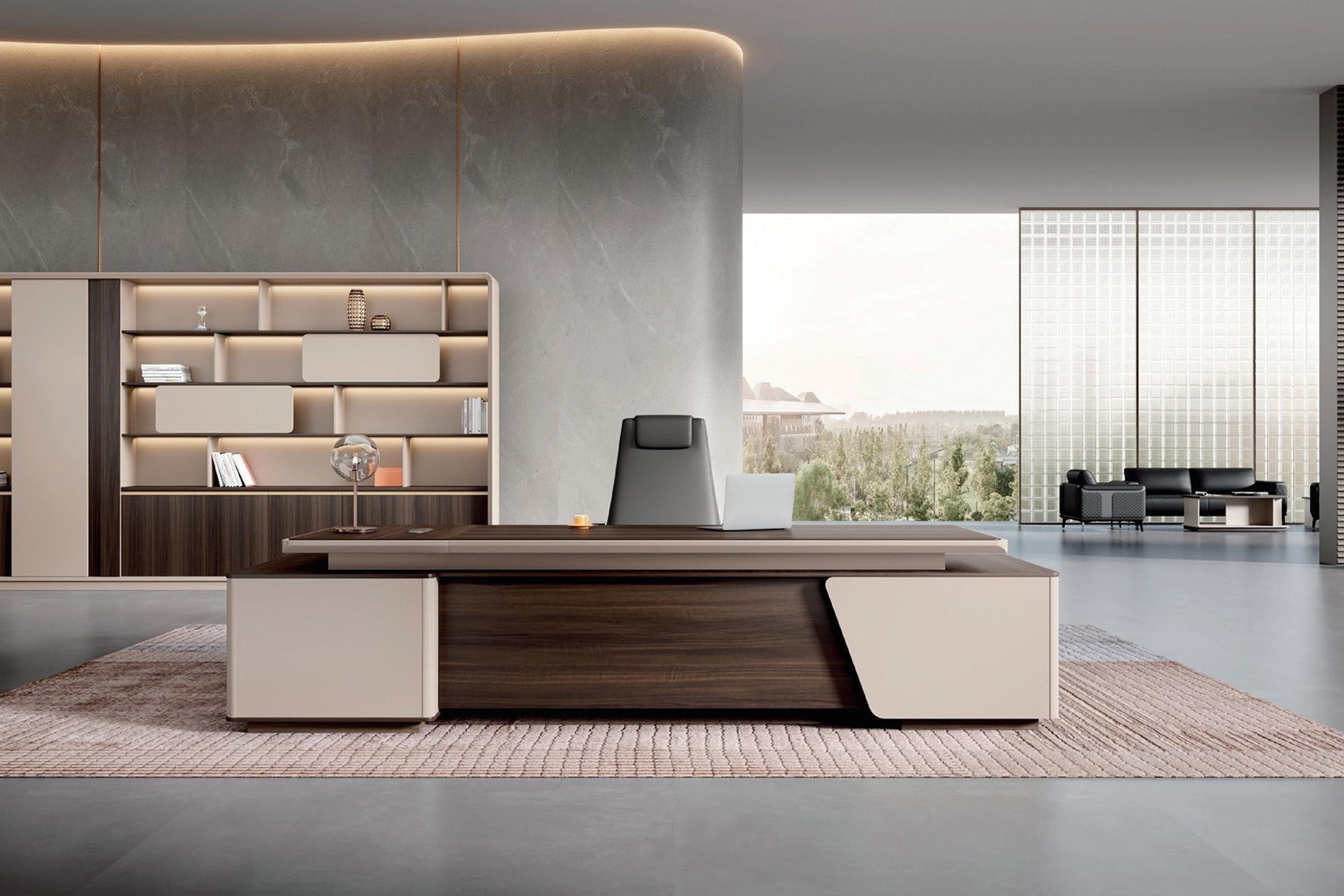
- Executive Presence: You may now need a dedicated Executive Office. An L-shaped desk in a dark walnut or an "Italian Minimalist" glass finish provides the necessary gravitas for sensitive leadership meetings.
Phase 3: Furnishing for 50 Employees (The Established Organization)
At 50 employees, your office is no longer just a room; it is a corporate campus. You are managing multiple departments, HR requirements, and a constant flow of visitors.
Spatial Strategy: The "Neighborhood" Concept
For 50 people, the office should be divided into "neighborhoods"—distinct areas for Finance, Marketing, Operations, and Sales, each with tailored furniture solutions.
- The Benching Evolution: Use long-run modular benching (rows of 6 or 8) for high-density departments like Sales. Ensure these have robust under-desk cable trays to hide the massive amount of wiring required for 50 active workstations.
- Collaboration "Third Spaces": Beyond desks, you need "soft" furniture. Create breakout zones with curved bouclé sofas, coffee tables, and "pebble" ottomans. These areas encourage "serendipitous collaboration" that doesn't require a formal meeting invite.
- Storage and Logistics: 50 people generate significant clutter. Implement a Smart Locker System for personal belongings and high-density lateral files for departmental archives.
- The Reception Statement: At this size, a dedicated reception area is mandatory. A custom-built, 126" marble or high-pressure laminate (HPL) reception desk serves as the "anchor" of your brand identity, signaling to every visitor that your company has arrived.
The Universal Checklist for All Sizes
Regardless of whether you are ordering 10 desks or 50, keep these technical specifications in mind:
1. Power and Data Connectivity
Never rely on floor outlets alone. Ensure your desks have integrated cable management. For a 50-person office, a "Wireless" aesthetic is only possible if your furniture features internal "umbilical" cord risers that keep cables organized as desks move from sit to stand.
2. Dimension Precision
Measure your space in millimeters for accuracy, then convert to inches for procurement if necessary.
- Standard Workstation: 55" x 27.5"
- Executive Desk: 71" x 35.5"
- Circulation Space: Always leave at least 47” walking space behind seated employees to comply with safety codes.
3. Material Durability
Residential furniture will fail in a commercial environment. Insist on Melamine Faced Chipboard (MFC) or High-Pressure Laminate (HPL) for desktops. These materials are scratch-resistant, heat-resistant, and easy to sanitize—vital for high-traffic offices.
Summary: Furniture Needs by Headcount
| Team Size | Primary Desk Style | Essential Meeting Space | Key Aesthetic |
|---|---|---|---|
| 10 People | Face-to-Face Benches | 1 Multi-purpose Boardroom | Japandi / Light Wood |
| 20 People | 120-Degree Workstations | 1 Boardroom + 2 Huddle Rooms | Scandinavian / Clean |
| 50 People | Modular Benching + Pods | 2 Boardrooms + 4 Breakout Zones | Italian Minimalist / High-End |
Conclusion: Investing in Your Foundation
Furnishing an office for a growing team is a balancing act between the "Now" and the "Next." For 10 employees, focus on agility. For 20, focus on acoustics. For 50, focus on organizational structure and brand prestige.
By choosing modular systems and ergonomic essentials, you ensure that your furniture doesn't become a bottleneck as you scale. Remember, a chair is not just a place to sit—it is where your next big idea will be born. Plan with precision, invest in quality, and build a workspace that inspires your team to reach the next milestone.
To bring these strategies to life, explore our curated collection of reception desks, conference tables, executive desks, and office seating—designed to scale with your team and elevate every stage of your workspace.


